
Imagine manufacturing patient-specific implants within hours, lightening entire aircraft fleets with intricate lattice structures that generate almost no material waste, or bringing consumer goods production closer to the point of use with supply chains that adapt instantly to changing demand. These futures are plausible with Additive Manufacturing (AM) if AM systems can run with reliability, speed, and coordination. Yet the gap between AM’s potential and its current practice remains wide, shaped not only by the limits of the printers themselves but by the limits of how we organize and coordinate them [1].
Over the last two decades, AM has moved far beyond prototyping, into aerospace, healthcare, automotive production, and beyond. Modern printers are faster, more reliable, and capable of producing industrial-grade parts at scale. Yet, in many factories, machines still sit idle, orders miss due dates, and capacity is wasted [2]. As AM technology has matured, the limiting factor is no longer necessarily how well we can print parts, but how we decide what to print, where, and when.The bottleneck is shifting away from the machines and toward the way production is managed and scheduled around them.
Recognizing this gap, a team of researchers from the University of Coimbra, led by former PhD student Paulo Nascimento and supervised by Professor Samuel Moniz, with support from collaborators at MIT and Princeton University, set out to understand what stands between AM’s current capabilities and its most ambitious promises.
The hidden complexity of production scheduling in Additive Manufacturing
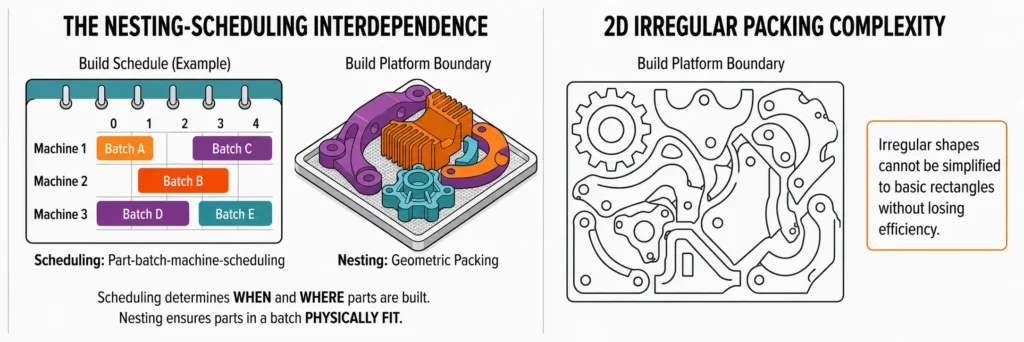
Despite all improvements, AM machines remain capacity-constrained and often slow and expensive to operate. Every minute of machine time matters, placing production scheduling high on the list of operational priorities, but scheduling alone does not capture the full problem. In AM, a batch of parts can only be produced on the same machine if the parts physically fit within the machine’s build platform without overlap – a geometric requirement known as nesting problem. In turn, an AM schedule is only viable if every batch it contains satisfies this constraint [3].
Nesting and scheduling are thus inseparable decisions, not sequential steps. Yet many existing scheduling models sidestep this reality. They replace geometry with crude proxies – total area, bounding boxes, or fixed batch sizes [4]. These simplifications make models easier to solve, but they come at a price. Solutions that look good on paper can translate into infeasible schedules, inefficient machine use, late deliveries, and substantial hidden costs once they meet the factory floor [5].
Why naïve integration does not scale
One obvious response is to fully integrate nesting and scheduling into a single optimization model. This thesis does exactly that, but doing so immediately exposes a second barrier: computational scale. Scheduling is already combinatorial. Nesting is geometrically complex. Combining the two produces models that grow explosively even for modest instance sizes. Solving everything “at once” quickly becomes intractable for anything resembling an industrial workload [6].
This is the core tension the thesis addresses: integration is necessary, but naïve integration does not scale.
A methodological shift: decoupling without simplifying
The key methodological shift is to separate nesting and scheduling without breaking their interdependence. This is achieved through logic-based Benders decomposition, a framework that allows different aspects of the problem to be handled by different reasoning engines while still converging toward globally consistent decisions.
At a high level, scheduling decisions – such as assigning parts to batches and machines – are handled in a master problem. Nesting decisions – checking whether a given batch can actually fit on a platform – are delegated to specialized subproblems that reason explicitly about geometry. When a batch turns out to be infeasible, the system does not simply fail; it learns. Information from the nesting failure is translated into precise feedback that steers future scheduling decisions away from similar dead ends [5].
Making decomposition work in practice
Decomposition alone, however, is not a silver bullet. Logic-based Benders decomposition introduces its own operational challenge: it relies on an iterative exchange between a scheduling master problem and a collection of nesting subproblems, and poorly designed iterations can waste vast amounts of computation.
To address this, the thesis develops a set of targeted acceleration strategies that fundamentally change how the decomposition behaves. These strategies exploit structural properties of the problem to avoid redundant work: guiding the master problem toward solutions that are more promising from a nesting perspective, terminating unproductive searches early, and strengthening the information returned from infeasible nesting attempts. Computational effort is focused where it matters most, ensuring that expensive geometric checks are performed only when they can meaningfully influence scheduling decisions.
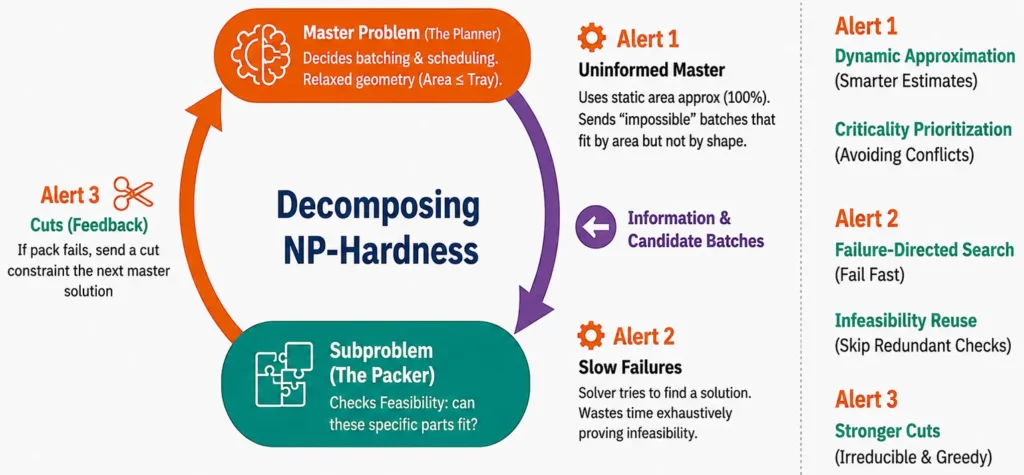
The result is a decomposition framework that behaves less like a brute-force validator and more like an intelligent decision-support system. Computational experiments on newly designed benchmark instances that reflect the scale and heterogeneity of real AM production environments show that these enhancements dramatically reduce solution times while preserving exact reasoning. These datasets are publicly released, providing a shared reference point for future research and enabling transparent comparison across methods.
Importantly, the ideas extend beyond AM, illustrating how domain knowledge and algorithmic structure can turn decomposition from a theoretical construct into a practical tool for complex production scheduling problems [7].
Geometry meets hardware-aware optimization
Even with decomposition, nesting remains a bottleneck at scale. Industrial AM environments can involve dozens or hundreds of uniquely shaped parts, often with multiple allowable orientations. Exact geometric reasoning, while essential for credibility and benchmarking, is not always the right tool for large-scale, time-critical decisions.
To address this, a geometry-aware nesting framework built on rasterization and Fast Fourier Transforms (FFT) is introduced. By converting geometric overlap checks into convolution operations, nesting feasibility can be evaluated orders of magnitude faster than with classical polygon-based methods. Crucially, this framework is designed to exploit modern hardware, namely GPUs, aligning optimization methods with current hardware capabilities.
Crucially, this is not geometry for geometry’s sake. The framework is built to integrate directly with scheduling heuristics, enabling large-scale instances to be tackled with high-quality solutions when full exactness is impractical. It reflects a pragmatic view of industrial decision-making: use exact methods where guarantees matter, and fast, hardware-aware heuristics where responsiveness and scale dominate.

What changes for real AM production systems
Across exact models, decomposition methods, and hardware-accelerated heuristics, the research paints a coherent picture of what becomes possible when AM scheduling is treated with the seriousness it demands.
Schedules become physically feasible by construction, rather than by assumption. Most importantly, production decisions become reliable enough to support automation and scale – two prerequisites for AM’s broader industrial adoption.
The work bridges a persistent gap between optimization theory and manufacturing practice. It shows that exact methods are not inherently impractical for AM, but only if they are designed around the real structure of the problem instead of forcing that problem into classical molds.
Beyond additive manufacturing
Beyond AM, the thesis carries a broader message. Manufacturing revolutions are not driven by machines alone, but by the algorithms that decide how those machines are used.
Just as semiconductor fabrication depends on sophisticated planning tools, the future of automated, distributed AM production hinges on intelligent scheduling systems that can reason about geometry, capacity, and timing at once. Advanced optimization, grounded in rigorous modeling and accelerated by modern computing, is not just helpful but essential.
By rethinking how AM production is scheduled—and by recognizing that scheduling in AM is inseparable from geometric feasibility—this work lays the computational foundation for AM systems that are not only technologically advanced, but operationally intelligent.
Additive Manufacturing began with the promise of printing anything, anywhere. Fulfilling that promise depends on making the right decisions long before the first layer is printed.
References
[1] J.M. Framinan, V. Fernandez-Viagas, P. Perez-Gonzalez, An overview on the use of operations research in additive manufacturing, Springer US, 2023. https://doi.org/10.1007/s10479-022-05040-4.
[2] J. Maranha, P.J. Nascimento, T.A. Calcerano, C. Silva, S. Mueller, S. Moniz, A decision-support framework for selecting additive manufacturing technologies, Journal of Manufacturing Technology Management (2023). https://doi.org/10.1108/JMTM-02-2023-0047.
[3] J. Zhang, X. Yao, Y. Li, Improved evolutionary algorithm for parallel batch processing machine scheduling in additive manufacturing, Int. J. Prod. Res. 7543 (2020). https://doi.org/10.1080/00207543.2019.1617447.
[4] M. Pinto, C. Silva, M. Thürer, S. Moniz, Nesting and scheduling optimization of additive manufacturing systems: Mapping the territory, Comput. Oper. Res. 165 (2024) 106592. https://doi.org/10.1016/j.cor.2024.106592.
[5] P.J. Nascimento, C. Silva, C.H. Antunes, S. Moniz, Optimal decomposition approach for solving large nesting and scheduling problems of additive manufacturing systems, Eur. J. Oper. Res. 317 (2024) 92–110. https://doi.org/10.1016/j.ejor.2024.03.004.
[6] P.J. Nascimento, C. Silva, S. Mueller, S. Moniz, Nesting and Scheduling for Additive Manufacturing: An Approach Considering Order Due Dates, in: J.P. Almeida, C.S. Geraldes, I.C. Lopes, S. Moniz, J.F. Oliveira, A.A. Pinto (Eds.), Operational Research. IO 2021. Springer Proceedings in Mathematics & Statistics, Springer, Cham, 2023: pp. 117–128. https://doi.org/10.1007/978-3-031-20788-4_8.
[7] P.J. Nascimento, C. Silva, C.H. Antunes, C.T. Maravelias, S. Moniz, Improving the efficiency of Logic-based Benders Decomposition for p-batch scheduling problems with two-dimensional packing, Eur. J. Oper. Res. (2026). https://doi.org/10.1016/j.ejor.2026.01.034.