
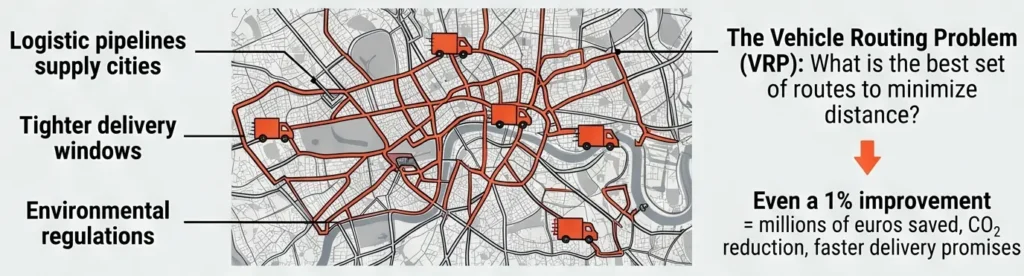
The logistic pipelines that supply cities and industries are increasingly complex, facing tighter delivery windows, environmental regulations and high operational costs. Around the world, fleets of delivery trucks trace intricate patterns across maps every hour of the day. Groceries, medicines, parcels, construction materials, they all depend on solving a deceptively simple question: what is the best set of routes for all vehicles to minimize distance? In practice, this “simple” question becomes one of the hardest computational problems in operations research, the vehicle routing problem (VRP). For global logistics companies that dispatch tens of thousands of vehicles, even a 1% improvement in routing efficiency translates into millions of euros saved per year, reductions in CO₂ emissions and faster delivery promises that define modern commerce.
Over the past two years, PhD student Arthur Corrêa and collaborators, supervised by Professor Samuel Moniz, have produced a pair of breakthrough studies that reshape how learning-based systems approach the VRP – TuneNSearch and FiLMMeD. Together, these works push neural combinatorial optimization closer to a long-standing goal: fast, general, adaptable solvers capable of handling the wide diversity of real-world logistics tasks.
The First Breakthrough: TuneNSearch—Learning to Route by Transferring Knowledge
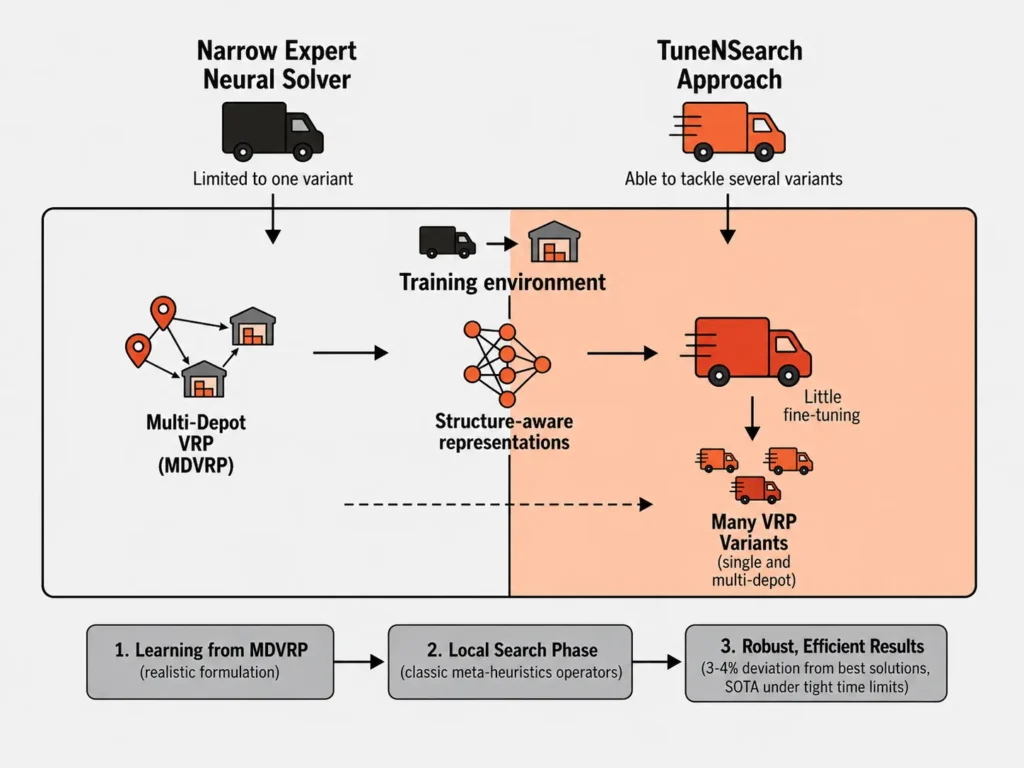
TuneNSearch is a hybrid transfer learning and local search framework that attacks one of the field’s biggest bottlenecks: the inability of neural-based models to generalize across VRP variants.
Most neural VRP solvers are narrow experts – excellent at one problem variant, but sensitive to changes. TuneNSearch challenges this by starting from a richer training environment, the multi-depot VRP (MDVRP), a formulation far more realistic than the single-depot case. By learning from this environment, the neural-based model acquires structure-aware representations that transfer well to many other VRP variants (both single and multi-depot) with little fine-tuning.
To boost robustness on larger instances, TuneNSearch integrates a local search phase that refines the neural solution using classic operators from VRP meta-heuristics, adding minimal computational burden while producing substantial gains. This allows to outperform state-of-the-art methods[1] under tight time budgets, and to achieve average deviations of only 3-4% from the best-known solutions across widely used benchmark sets[2]. The result is a solver that learns fast, adapts quickly, and remains practical for real-time decision making.
The Second Breakthrough: FiLMMeD—A Foundation Model for Routing Constraints
If TuneNSearch explores how models can transfer knowledge, FiLMMeD investigates a complementary question: can a single model learn to handle a diverse ecosystem of routing constraints at once?
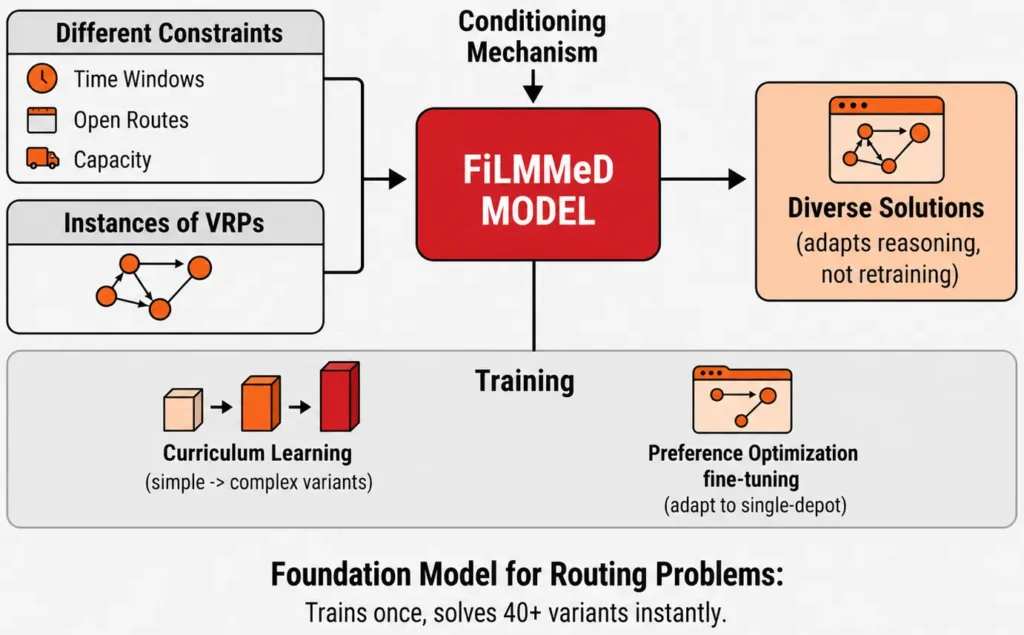
VRPs vary not only in size but in rules, some involve time windows, others allow open routes, and so on. FiLMMeD uses a conditioning mechanism that tells the model which rules apply to each instance. In response, the neural network shifts how it interprets distances, demands and other relevant instance-dependent information. Instead of retraining a new model for each scenario, FiLMMeD adapts its reasoning to the constraints it is given.
Training is guided by a curriculum that starts with simpler cases and gradually introduces more complex combinations. A preference optimization fine-tuning method then helps the model effectively adapt to single-depot variants. Overall, FiLMMeD achieves competitive performance across 40 distinct problem variants. When combined with TuneNSearch’s local search procedure, both methods can deliver highly flexible and scalable solutions across a wide variety of routing problems.
In essence, FiLMMeD acts as a foundation model for routing problems, trained once on a massive and constraint-rich family of MDVRPs, it can instantly solve both multi and single-depot variants with high accuracy.
A Unified Research Story: Toward Adaptable, Efficient, and Real-World-Ready Routing AI
Taken together, TuneNSearch and FiLMMeD outline a powerful research trajectory:
1. Start from realism, not simplicity – MDVRP proves to be a powerful foundation for training.
2. Combine learning with optimization for practical performance – rather than discarding decades of VRP heuristics development, this work integrates classic optimization with modern neural frameworks to enhance performance.
3. Toward universal routing models – FiLMMeD pushes the field closer to a long-desired holy grail: a single model capable of handling the messy heterogeneity of real-world logistics.
From Industry Impact to the Future of Operations
These neural-hybrid methods deliver high-quality solutions for large-scale VRPs using only a fraction of the computing and tuning effort required by traditional solvers. For major carriers, online retailers and last-mile delivery services, the benefits are tangible: more reliable service promises, lower costs, and more sustainable distribution, often achievable in near real time.
Just as important, the models adapt quickly. City layouts, delivery regulations, fleet sizes, and service promises evolve constantly. Unlike other approaches, these learning-based frameworks can follow suit with little retraining, dramatically reducing the engineering and deployment costs that currently slow down industrial optimization.
Ultimately, this work is not only about better algorithms, it is about equipping industry with smarter, greener and more resilient decision-making tools that touch consumers, commerce and communities worldwide.
[1] POMO, OR-Tools, PyVRP
[2] CVRPLIB, TSPLIB, and Cordeau’s MDVRP library
