
Modern manufacturing floors no longer resemble the tidy job shops of classical textbooks. They are dynamic ecosystems where a single poor scheduling choice can ripple through the system, delaying deliveries, wasting capacity, and eroding margins. Yet the very complexity that makes these systems valuable also makes them hard to control.
For factories operating under tight margins, scheduling is crucial. It is a daily operational struggle with direct economic consequences. At the same time, expectations are rising: schedules must adapt in real time and scale across dozens of machines without constant human intervention. Recently, PhD student Alexandre Jesus, supervised by professor Samuel Moniz, have produced a pair of studies that show how optimization and learning-based systems can be combined to make fast and reliable scheduling decisions in such environments.
Recently, PhD student Alexandre Jesus, supervised by professor Samuel Moniz, have produced a pair of studies that show how optimization and learning-based systems can be combined to make fast and reliable scheduling decisions in such environments.
The Fundamental Bottleneck: Speed Vs Reliability
For decades, Operations Research has offered powerful tools for scheduling. Exact optimization methods can produce schedules that are provably near the best possible, but as systems grow larger, computation times explode, and waiting for a solver is often not an option – even a perfect schedule is useless if it arrives late. To cope with this, industry often turns to heuristics, which are fast and simple but sacrifice global reasoning and struggle when systems become highly flexible.
Learning-based approaches, particularly deep reinforcement learning (DRL), promise a different balance. In practice, however, naïve applications of DRL to scheduling have struggled. Learned policies are often brittle and sensitive to modelling choices.
A Research Program Built on Bridging the Gap
Alexandre’s work addresses this dilemma by treating optimization and learning not as competing paradigms but as complementary ones. Instead of using optimization as a baseline to beat, their work uses it as a source of structure, explanation, and guidance for learning-based systems.
Across two closely connected papers, the first aims to understand why learning-based schedulers behave as they do, while the second turns those insights into a concrete and deployable system. Seen together, the work shows how optimization can act not only as a solver but as a teacher.
Diagnosis Before Prescription
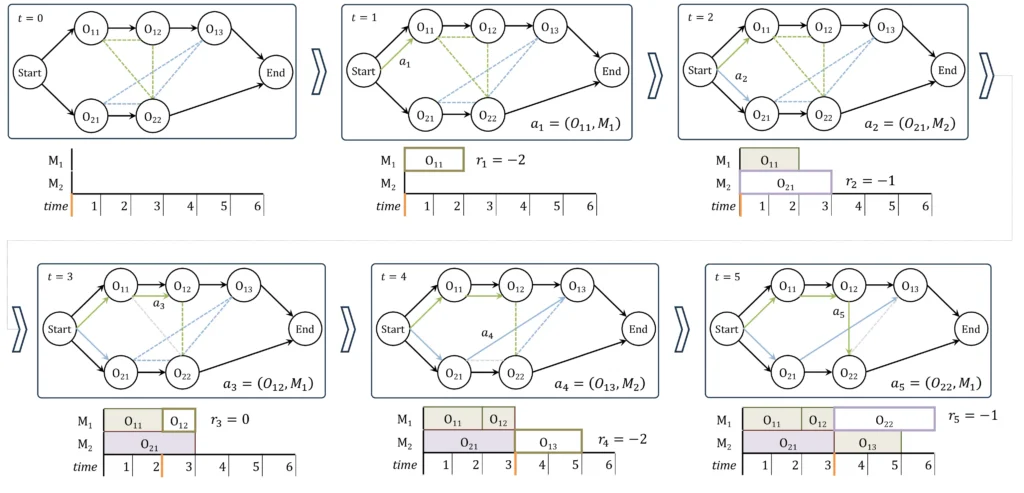
The first paper starts with a simple question: why do some DRL schedulers work well in certain settings and fail in others? Focusing on the flexible job-shop scheduling problem, modelling choices typically taken for granted, such as action definitions and reward design, are examined. Besides, constraint programming is used as a reference point. By computing bounds and near-optimal solutions on representative instances, optimization becomes a lens through which learning behavior can be interpreted.
This optimality-driven perspective exposes patterns that are usually hidden. Whether an agent should choose a job or a specific operation depends strongly on machine heterogeneity and flexibility. Reward signals that appear reasonable in homogeneous settings can mislead learning when variability increases. What looks like algorithmic instability often turns out to be a mismatch between modelling assumptions and problem structure.
Optimization is not used only for analysis. The paper introduces a hybrid learning strategy in which expert solutions generated by constraint programming are injected into a multi-agent Deep Q-Learning framework. These demonstrations guide early exploration, stabilizing learning and accelerating convergence without locking the policy into pure imitation. The result is a lightweight, decentralized scheduler that narrows the gap to optimization while preserving the speed of learning-based approaches.
From Insight to System: Enter PRISMA
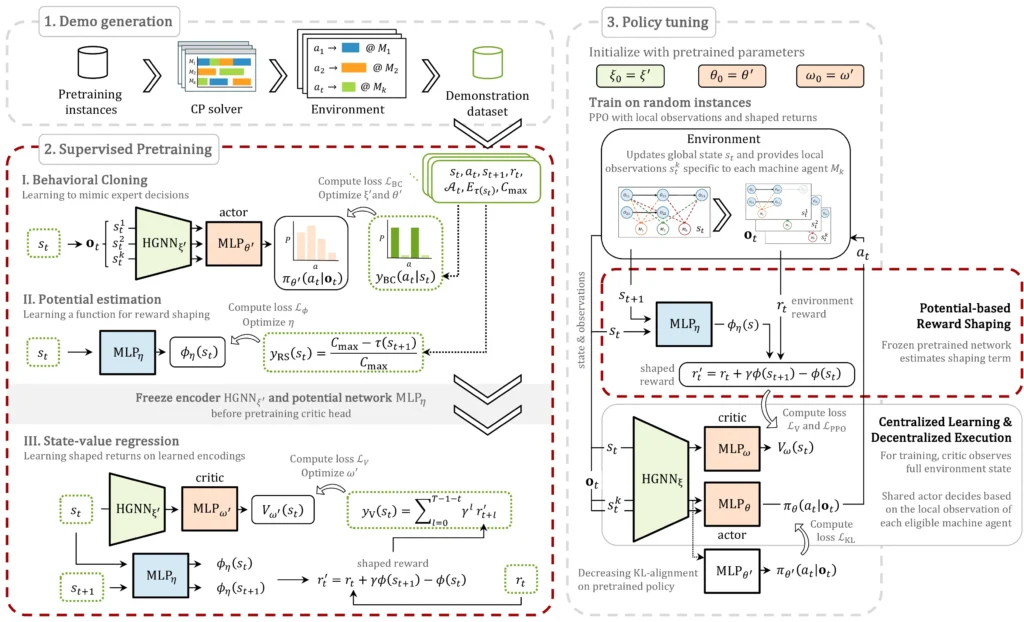
Where the first paper diagnoses and explains, the second paper builds a system. Under the name PRISMA, Alexandre turns optimization-guided learning into a full-fledged, multi-agent scheduling framework designed with deployment in mind.
PRISMA operationalizes the earlier insights by integrating optimization in three complementary ways. First, solver-generated schedules are used for imitation learning, aligning initial agent behavior with high-quality decisions. Second, the same expert data are used to learn a potential function that estimates progress through a schedule, shaping reinforcement signals during training without altering the underlying objective. Third, optimization-derived returns are used to stabilize value estimation early on, improving coordination among agents.
Each machine acts based on local information, mirroring how real factories operate. At the same time, training is coordinated so that agents learn to cooperate rather than compete. A shared graph-based representation transfers system-level structure into local views, ensuring that decentralized decisions remain globally consistent.
The outcome is not just improved solution quality, but faster convergence, greater stability, and reduced sensitivity to modelling choices, i.e., properties that often determine whether a scheduling system can move from the lab to the factory floor.
Why This Matters Beyond Benchmarks
The practical implications extend well beyond flexible job-shop benchmarks. In manufacturing systems where schedules must be updated continuously, PRISMA-like agents can deliver high-quality decisions at machine speed. Heavy optimization is pushed offline into training, while runtime inference remains fast enough for real-time control.
The same logic applies to logistics, routing, and other operational domains where decisions are sequential, distributed, and constrained. Any setting in which optimization is powerful but slow, and learning is fast but unreliable, stands to benefit from this synthesis.
Equally important is trust. By grounding learning in optimization, these systems offer decisions that are not only fast, but defensible. Learned policies are shaped and evaluated relative to principled models of the underlying problem, making their behaviour easier to reason about.
A Broader Shift in How AI and Optimization Work Together
Taken together, Alexandre’s two papers point to a broader shift in how AI for operations should be built. Progress does not come from discarding decades of optimization knowledge in favor of ever-larger neural architectures. It comes from distilling that knowledge into forms that learning systems can use continuously.
By treating constraint programming as both a compass and a teacher, this work moves the field closer to AI schedulers that can be trusted to run the complex and time-critical systems that underpin modern manufacturing and logistics.